Sunday, 19 February 2017

Group F1 - User Testing


Usability testing is known as User Testing to evaluating a product or service by testing it with representative users. Typically, during a test, participants will try to complete typical tasks while observers watch, listen and take notes.


Goal:

To collect the qualitative data from the users thus identify the problems within.

Types of User Testing:


  • Moderated user testing:
The moderator guide and observe the participants throughout the process
  • Unmoderated user testing
The moderator doesn't guide the participant throughout the process

Variations of User Testing:
  • Hallway testing
Pick participant randomly around the area for testing
  • Remote user testing
Participants are pick from out of the country or rural areas
  • Expert view
Hired experts that have knowledge about the product to test
  • Automated expert review
Using scripted programs to test out the product
  • A/B Testing
The participant will test which version of the product is better

Advantages of User Testing:

  • Cost
Effective usability testing does not require a formal usability lab for testing
  • Fast Implementation
The procedure is quick and easy
  • Amount of testing you can afford
An indirect second benefit of the reduced cost is that you can afford to do much more testing, testing of your existing site, your proposed solution (at multiple stages) and your final product
  • Comfort factor
Users are participating in the testing in a more natural, real-world environment, where they feel more comfortable and are more likely to be themselves

Disadvantages of User Testing:

  • Testing Junkies
Testing junkies are there just for the cash and take a number of tests
  • Trouble with finding an accurate audience
  • Security (mostly remote usability testing)
Is hard for the moderator to get an accurate data when your own participant is anonymous
  • Body Language (mostly remote usability testing)
Testers quite often come from a psychology background and can learn a lot from interpreting a participant's body language. This is lost altogether with online testing
  • Remoteness (mostly remote usability testing)
It's hard to hand somebody a physical handout or flyer and ask them to go online and do what they would normally do in the real world if they're halfway around the world in a different country

Thursday, 2 February 2017

Week 5 Watching Avatar Movie

1) In Intensive Interviewing, the person giving the information is called an ‘informant’. Name the ‘informant’ in the movie and explain how he/she shares information with the researcher. 

The informant is Jake Sully, He joins the Avatar program because his twin brother died, and they wanted to replace Jake because they have similar genetic. Jake will receive a lot of money to fixed his leg by finish the mission to get the 'unobtanium' minerals at Hometree from Na'vi. By doing that, Jake need to befriend with the Na'vi first and befriend with them by learning their culture and way of living at Hometree. By knowing how Jake is doing on his mission, every night he will do log post of how he is learning day by day with Na'vi and telling the location of Hometree more exact. At first, he just wanted to finish his mission but later he falls in love with Neytiri and helps the Na'vi people to defeat the sky people together with Jake, Max, Norm. and Trudy.

In Field Studies, there are four (4) types of researchers. Overt Participant Observer, Overt Non-Participant Observer, Covert Participant Observer and Covert Non-Participant Observer. 

Overt Participant Observer
Researcher watching Jake videos to know his status and what he is doing in the Hometree with Na'vi people.

Overt Non-Participant ObserverResearcher joining the group he studying and known by his/her status.

Covert Participant ObserverThe researcher not joining in the group while studying, but the status is unknown to the group.

Covert Non-Participate Observer
The researcher studying while not participating in the group, and his status is also not known to the group.

2) The researchers in the movie are overt observers. Name the character that is a participant observer and the one that is a non-participant observer. Describe how both of them collect information. Field Studies is a combination of emic and etic research. 

Jake Sully is the Participant Observer. He learns the Na'vi way of living and gives the information to the Private security force.
Dr. Grace Augustine is the Non-Participant Observer. She collects information and researchers their culture and way of living by educating the Na'vi and learn their language. She does not support the colonel action of burning the Hometree and kill a lot of Na'vi that gets in his way of getting the minerals.

3) In the movie, describe the kind of information gathered that can be constituted as emic/etic data
Emic dataEmic is the insider view, it focused on their bond with the creatures and Eywa, their god, and understanding their way of life in the Hometree of how they talk, hunting, learning their culture, pray for Eywa, their god, bonding with their fated one, etc. Like when they are hunting the creatures, they will kill and pray for their souls to be with Eywa. When they died, they believe that their souls join with Eywa and soon will be reborn again.

Eitc data
Etic is the outsider view, focus from local observations. Both Jake and Dr. Grace learn about Na'vi culture and way of living and their own world and knowing the situation of both sides.

Friday, 20 January 2017

Research

1. Formative Research:
- Formative research helps you guiding the process by asking friends for advises and opinions for the project. The research can contain a lot of information base on the topic of the project.
- Planning with the clients for information that they wanted and needed to be a better understanding of the project.
- Teachers are allowed to examine the previous works and project to teach students what they are lacking.
- A summative assessment carried out at the end of the project to decide what made a successful or failure project. Whether it should be adopted by or changes for improvement.
- To understand your competitors of strength, weakness, and target business but also understanding your own profit and loss. From that point, you can earn profits between you and your competitors, thus, you need to plan ahead to gain your own profit.
- By doing that, you can avoid their bad assumptions, position effectively, improve your offering, and plan market entry. However, if the data is wrong or incomplete, it can give a bad reputation to the company. It also takes a lot of time to consume the data because the traditional competitors give many different choices of product and services.
- My conclusion is understanding both of the competitors and your own strengths and weakness so that you can use the previous information to help you in the future.

2. Persona:

  Target audience profiling is to set the persona and give them characteristic to the audience so that it is much easier to make them in sorting for each group. so that they could focus more on selling different products for various audiences. In the end, I prefer to collect many information and research before start doing the project. It is because the process is more simple and easy to change if the project needs any changes.

Friday, 10 October 2014

'Itasha'

Itasha (痛車, literally "painful car"), is a Japanese term for an otaku fad of individuals decorating the bodies of their cars with fictional characters of anime, manga, or video games (especially bishoujo game or eroge). These characters are predominately "cute" female. The decorations usually involve paint schemes and stickers. Automobiles are called itasha, while similar motorcycles and bicycles are called itansha (痛単車) and itachari (痛チャリ), respectively. The cars are seen prominently in places such as Akihabara (Tokyo), Nipponbashi (Osaka), or Oosu (Nagoya).

'Akihabara Anime'

Akihabara is sacred ground for Japan’s famous “otaku” (anime and video game fan) culture. The Tokyo Anime Center is located in Akihabara UDX, the core facility inside Akihabara Crossfield that serves a central role in the area.  Limited-time exhibitions will take place in the main space inside the centre, creating a PR booth that mainly features a large monitor showing popular movies and other offerings. Other monitors are placed at various locations to show the newest anime-related information from Japan. In addition, charity “mini concerts” are held in the recording studio inside the center, and anime charity auctions are held in the event space with unique items from anime-related companies. 

'Maid Cafes'

Maid cafes are cosplay themed restaurants where guests are served by waitresses that are typically dressed as French maids. In addition to serving food, the maids engage in conversation and games with the customers and treat them with the care and respectful language due to the master of a house. Maid cafes are popular with both men and women, especially men that are crazy with maids like Otaku.

'Akihabara'

Akihabara (秋葉原), also called Akiba after a former local shrine, is a district in central Tokyo that is famous for its many electronics shops. In more recent years, Akihabara has gained recognition as the centre of Japan's otaku (diehard fan) culture, and many shops and establishments devoted to anime and manga are now dispersed among the electronic stores in the district.

'The Way of The Empty Hand'

Karate is primarily a striking art, featuring punching, kicking, knee/elbow strikes and open hand techniques; however, grappling, joint manipulations, locks, restraints, throws, and vital point striking are inherent in the finer points of the art. Karate is characterized by the use of the hips and stances to generate striking power, by the distinctive use of breathing to focus power, and by the practice of prearranged forms. The prearranged forms are called kata. A person who practices karate is sometimes referred to as a karate-ka. In Japanese, karate-ka means "karate practitioner". Karate is also called karate-dō.

'The Way of Harmony of The Spirit'

Aikido, also known as 'The way of the Harmony of The Spirit', is a Japanese martial art. Aikido techniques allow one to overpower their opponent without much strength, and without injury to either party.
Aikido was created in Japan by Ueshiba Morihei in the first half of the 20th century. As in all the Japanese martial arts, mental training is essential in aikido. Students of aikido try to achieve harmony of their spirits.

'The Way of Softness'

The literal meaning of Judo is the Way of Softness. The kanji character for 'ju' is taken from a Chinese military saying that 'softness defeats hardness'. The emphasis in this sport is not on physical size or strength but on agility, balance and practise of waza, or techniques. The never-ending, repetitive practise of these waza or kata (forms) until they become as natural as breathing is central to all martial arts and takes up most of the time spent in the dojo.

'The Way of Bow'

Kyudo (the Way of the Bow) is Japanese archery, which has been practised since ancient times. Archery from horseback is still part of several festivals held each year. Archers wear a traditional costume which includes a yugake(deerskin glove) on the drawing hand and tabi (Japanese-style socks). They stand with a stance equal to half their height. The 2.21 meter bow is held with two thirds of the bow above the grip. As a martial art influenced by Zen Buddhism, the emphasis is on form rather than accuracy. In competition, there are long-range and short-range matches. In the former, the target is 100cm in diameter and 60m from the archer while in the latter, there is a 36cm target at a distance of 28m.

'The Way of Sword'

Also known as 'Kendo'. Sword fencing was probably introduced to Japan from 6th or 7th century China.The shinai is made of four bamboo shafts, bound with a silk or nylon cord and a leather thong. The length of the shinai depends on the age group of the fencer. The protective clothing has many parts, including a men or face mask, a do (chest) protector, quilted tare or flaps to protect the thighs and kote or fencing gloves. The strike zones are the head, throat, chest and forearms. The key elements are stance, footwork, cuts, thrusts, parries and feints. When training, fencers practise a series of offensive and defensive waza. Competition consists of a match of up to 5 minutes with the winner being the first to score 2 points. A clear hit to the opponent's head, torso or forearm or a thrust to their throat scores a point.

'Hanami'


The word hanami literally means "looking at flowers," but it is used to refer to one flower in particular, the sakura or cherry blossom. Every spring, people turn out in their millions across the country to celebrate the transient beauty of these flowers, one of the symbols of Japan itself. The appeal of the sakura goes beyond their evident beauty. It lies in the fact that the flowers are only in full bloom for a few days. The real "moment" of hanami is not so much looking at the flowers on the tree but watching with a tinge of sadness as they fall from the tree, flutter in the spring breeze on their short journey to the cold earth below. It's a beautiful but melancholy reminder that all life must come to an end. And to take the edge off what could become a depressing experience, the Japanese go all out to have a good time. They get roaring drunk, sing songs, tell stories, laugh and enjoy life to the fullest, if even just for a few hours. And if you want to get a good spot, you need to start early. In some cases, such as popular firework displays or on a warm weekend when the sakura are in full bloom, people will even start claiming their spots the night before. They'll put down their blue plastic sheets and maybe even camp out for the night.

'Chichibu Yomatsuri'

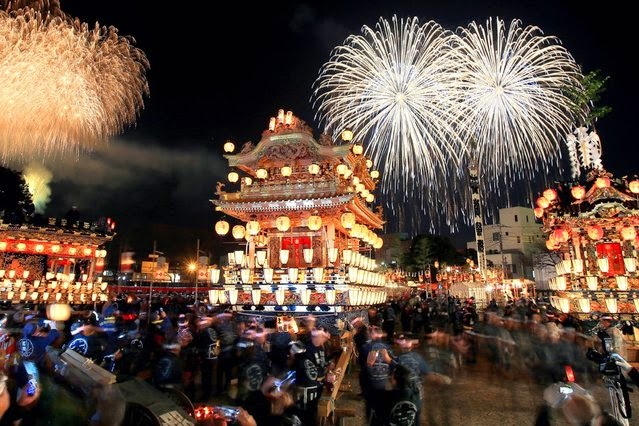
The Chichibu Night Festival (秩父夜祭, Chichibu Yomatsuri) is the festival of Chichibu Shrine in Chichibu City, Saitama Prefecture, just 90 minutes from central Tokyo. It is held every year on December 2nd and 3rd, with the main action taking place on the 3rd. Its floats are ornately decorated with lanterns, tapestries and gilded wood carvings and are accompanied by drum and flute music. Festival's other attraction is its fireworks display, which lasts almost two and a half hours and gives you the rare opportunity to enjoy Japanese fireworks during winter. Additionally, the streets are lined with stands selling festival foods and amazake (sweet rice wine) to combat the cold December night.

'Jidai Matsuri'

The Jidai Matsuri (時代祭) is a festival that takes place every year on October 22, the anniversary of the foundation of Kyoto. Jidai Matsuri is Japanese for "Festival of Ages", and the participants of the parade are dressed in accurate costumes from almost every period of Japanese history, as well as famous historical figures. There are about 2000 participants and it takes two hours to watch the entire procession pass by. The Jidai Matsuri is held by Heian Shrine, and both the festival and the shrine were established in 1895 to celebrate Kyoto's history and culture.

'Nagasaki Kunchi'

The Nagasaki Kunchi is the festival of Suwa Shrine, held annually in Nagasaki on October 7-9. The Nagasaki Kunchi has been celebrated for more than 370 years and incorporates different aspects of Chinese and Dutch cultures, which have played a role in the city's history. The festival's name is believed to come from ku-nichi ("9th day"), the ninth day of the ninth month of the lunar calendar. The festival highlight are dance and show performances by groups representing Nagasaki's various city districts. Each district (odori-cho), participates only once every seven years, so this festival remains fresh to even the regular viewer. About five to seven groups perform each year, presenting traditional Japanese dances, Chinese influenced dragon dances or performances involving large floats, many of which are shaped like ships. While some performances are calm and peaceful, others get wild and hectic.

'Kanto Matsuri'

This festival praying for an abundant harvest of the five grains, namely wheat, rice, beans, foxtail millet and Chinese millet. A kanto is a bamboo pole eight meters high with a number of cross poles attached which have 46 paper lanterns shaped like rice bales hanging from them, and is decorated at the very top with thin shreds of paper between wooden sticks. They act to drive away evil spirits through prayers offered to Shinto and Buddhist deities. At the festival, energetic youths dressed in short jackets, hachimaki headbands, white tabi socks and zori straw sandals take turns in hoisting up the kanto one at a time to the sound of flutes and drums. Then they parade through the town while ensuring that the lights of the paper lanterns do not go out. Hands are not used to support the kanto. The men prop the poles upright on their hips, shoulders or foreheads and change their postures while shouting stoically as they try to outdo each other. The origins of this festival lie in the serene Tanabata ritual, from an annual festival held on the evening of July 7th to worship stars, which is called neburi-nagashi for wiping out diseases and malicious energy inviting illness.

'Tenjin Matsuri'

The Tenjin Festival (天神祭, Tenjin Matsuri) of Osaka is ranked as one of Japan's top three festivals, along with the Gion Matsuri of Kyoto and the Kanda Matsuri of Tokyo. The festival started in the 10th century and today takes place on July 24 and 25 every year. The main celebrations are held on the festival's second day, July 25, including a land procession and a river procession with fireworks. Tenjin Matsuri is the festival of the Tenmangu Shrine and honors its principle deity Sugawara Michizane, the deity of scholarship. The festival involves inviting the deity out of the shrine and parading him through the city, carrying out various exuberant festivities to entertain him, before taking him back to the shrine. For the people, the lively festivities manifest in a wonderful occasion to enjoy the hot summer day, filled with traditional costumes, spectacular processions and a celebratory atmosphere.

'Gion Matsuri'

The Gion Matsuri, familiarly known as "Gion- san," is a festival held at Yasaka-jinja Shrine, and the highlight is the splendid pageant of some 30 floats called yamaboko proceeding along the main streets of Kyoto on the 17th. Each float, two- storied and about 6 meters tall, is topped with a long pole shaped like a spear. Adorned with exquisite craftwork such as woven fabric, dyed textiles and sculptures, these floats are so gorgeous that they are sometimes even described as "mobile art museums."  During the parade, children wearing make-up and musicians playing the flute, drums and bells are seated on the second level of the floats. Some floats have dolls propped up on the second level. This festival is believed to have started 1,100 years ago when floats were made and paraded in the town to appease the deity of plague and illnesses. 

'Hakata Gion Yamakasa'

The Hakata Gion Yamakasa (博多祇園山笠) is one of the most interesting festivals in Japan. It is held every year during the first half of July and climaxes with a spectacular time trial race in the early morning hours of July 15. In the race, seven neighborhoods of Fukuoka's Hakata district compete in pushing beautifully decorated festival floats along a five kilometer long course through the city. For the race, smaller sized kakiyama floats, about five meters tall and one ton heavy. The floats do not have wheels and are dragged through the streets, while water is spread in front of the float in order to reduce friction between the float and the road surface (and cool down the participants). From July 10 to 14, the seven teams hold several practice runs and parades in preparation for the main race. On July 15 just after 1am, all teams line up behind the start line, which is located in front of Kushida Shrine, the festival's host shrine.